SkyLaw Fall Update 2026
In this update, we explore the changing legal and investment landscape, highlight recent client work and insights, and catch up on the firm’s recent travels and activities.



There is a lot happening at SkyLaw and across the legal profession and tech industry this fall! In this update, we share how our firm is thinking about the future as we take a closer look at some of the forces reshaping law firms these days, from cybersecurity threats to sudden resignations and the growing influence of AI.
We also provide insight into Canada's current investment landscape and showcase some of our recent blogs, including an important one about increased scrutiny of federal corporate filings concerning individuals with significant control. We highlight some of the incredible clients and transactions that have been keeping us busy, and catch up on the firm’s recent travels, including Kevin’s return to Halifax to teach the next generation of corporate lawyers.
We are watching closely the news today of Jensen Huang's resignation from Nvidia and its impact on AI companies and the markets. Few cases so dramatically bring together founder power, board independence, succession, personal conduct, government relations, and international intrigue.
Mr. Huang co-founded Nvidia in 1993 and built it into the world’s most valuable company, with a market capitalization that recently exceeded US$5 trillion. As its share price has fallen amid the leadership crisis, approximately US$2 trillion in shareholder value has been erased from the company’s October peak.
We expect this will be a key case study in Kevin's corporate governance course at Dalhousie Law School for years to come.
On August 22, Prime Minister Mark Carney held a press conference explaining why Canada had suspended trade negotiations with the United States: “We were attacked. You’re at war when you get attacked. We got attacked.” The uncertainty weighed heavily on many Canadian businesses that rely on trade with the United States.
The negotiations have since resumed, and Prime Minister Carney said on November 3 that the United States was now “asking less” and “offering more”. Although the two countries have made progress and resolved some issues, significant differences remain, and no agreement has been reached.
We discuss the impact of tariffs and other geopolitical matters in our M&A guide that you can find here: SkyLaw's GLP Guide: M&A in Canada 2026.

Canada has released The Plan for a Stronger Canada: National Security for Canadians, its first national security policy in more than 20 years. The Plan treats economic strength as part of national security. Canada wants more control over the technology, infrastructure and resources on which it depends.
For international businesses and investors, the Plan is also an invitation to look at Canada. The government has identified emerging technologies, critical minerals, defence, energy, transportation, pharmaceuticals and biotech, food security and financial infrastructure as areas in which Canada intends to strengthen its capabilities and foster growth and investment, including through partnerships with international businesses and trusted allies.
The 2026 federal budget, released last week, is designed to make new investment in Canada more attractive. Its Productivity Mega Deduction is expected to lower the marginal effective tax rate on new business investment from 13% to 6.4%. The Budget also expands the SR&ED program and introduces new incentives to encourage investment in growing Canadian businesses.
For international investors, the broader message may be even more significant. The government has described the coming period as an “Investment Supercycle” with opportunities for public priorities and private investment to overlap, particularly in areas such as energy, infrastructure, critical minerals and advanced technologies.
Canada remains an excellent place to establish, invest in and grow a business.
We encourage our international clients and friends to speak with us whenever Canada comes onto their radar, whether there is a specific transaction in mind, a business opportunity to explore, or simply an idea worth discussing.

In late October, a number of large Canadian law firms disclosed that they were subjected to a vishing attack: a phishing attempt using a voice call instead of email for the purpose of stealing log-in credentials. This was social engineering designed to exploit the ordinary professional instincts of responsiveness, collegiality and trust.
According to The Globe and Mail, fraudsters contacted lawyers and staff while impersonating internal IT support in order to get passwords and two-factor authentication codes. Once employees granted access, the imposters entered cloud accounts and obtained files, including client-related information.
At least four major firms confirmed compromises. The first public reports of the breach came early in the week, with the list of affected law firms surfacing gradually over the following days. The breadth and scope of the hack has sent shock waves through the legal profession.
There are as yet no verifiable reports of who was behind the attack nor the extent to which AI was used. The Government of Canada’s Centre for Cyber Security has been following the course of these attacks and provides more information here, including suggested actions you can take to protect your organization.
The other shock that week came from New York: Weil, Gotshal & Manges LLP announced plans for an orderly wind-down after the firm failed to stop a succession of partner departures. On November 10, the partnership voted to proceed with the dissolution.
Weil was founded in 1931. The firm had approximately 1,200 lawyers and over 2,000 employees in total, and generated more than US$2 billion in revenue in the previous year. Weil was best known for representing companies going through bankruptcy. It acted for the debtors in six of the ten largest US bankruptcy filings, including Enron, General Motors and, notably, Lehman Brothers.
The Lehman Brothers collapse in 2008 is often remembered as a defining moment in the global financial crisis. It is hard not to wonder if Weil’s own collapse could turn into the legal profession’s Lehman moment.
In September, The Economist article “Big Law’s century-old business model is being transformed” described how the law firm partnership model is looking more like a sports league as high-priced partners jump for more money from rival law firms. On October 28, The Economist wrote about Weil’s collapse: “And just like that, an institution that existed at the apex of corporate America for nearly a century is more or less finished. Weil, Gotshal & Manges, a firm of lawyers, has suffered what can only be described as a run on the bank.” There is some worry that one run on the bank can lead to more; partners at all firms are likely thinking carefully about their own situations.
There have been some notable law firm failures in the past. In Canada, Heenan Blaikie LLP dissolved in 2014 in broadly similar circumstances. It remained profitable and well regarded, but declining partner confidence culminated in the departure of nearly 30 senior partners within about a week, making the firm’s continuation unsustainable. Its collapse was no doubt a devastating ordeal for nearly 500 lawyers and 1,000 staff, and often created significant disruption for clients as their files were transferred. The financial and professional consequences took years to resolve.
A firm must continually earn the confidence of its lawyers, staff and clients, which is becoming increasingly challenging in today’s environment.
What comes next? After Weil announced its proposed dissolution, Crosby, a two-year-old AI-native law firm, reportedly offered to acquire Weil’s name, brand and some of its internal data, while seeking to recruit some of its lawyers.
Most traditional law firms are adding AI tools to their existing structures and workflows. An AI-native firm uses AI to set up its workflows from the beginning, then adds human judgment at the most efficient points. Nimble next-generation law firms may focus on hiring lawyers for the specific tasks that require lawyer judgment instead of building a pyramid of lawyers based mostly on years of experience.
Last month, SkyLaw celebrated its 16th anniversary. Founded on October 27, 2010, SkyLaw launched as an innovative law firm using cloud computing and Apple computers to efficiently connect talented lawyers with clients. We have always put technology, efficiency and experience at the forefront of our ethos.
We closely follow developments in the legal industry and talk to law firms in Canada and around the world. The events of the past few weeks have given us pause. We continue to think about the concrete steps we should be taking to safeguard our future. Here is some of what we are doing:

SkyLaw has a full-time, in-office technical professional with the enviable title of “Strategic Technology Advisor & Solutions Architect”. We are continually monitoring our systems and deploying new technologies as they develop. We regularly meet as a group and share best practices. Our defensive posture is that “we are constantly under attack”, and so we are vigilant and aware of the potential threats. We use the tools available to us and educate ourselves to reduce the risks as much as possible.
When the hack of the large law firms happened last week, we gathered intelligence from our colleagues and used our AI platform to review the facts and make suggestions for improvements in our processes. Best practices in cybersecurity are constantly evolving, and our AI platform is excellent at helping us analyze the situation and identify potential improvements.
We take a ground-up approach to becoming AI-native. Rather than layering AI onto existing processes, we are rethinking workflows from the ground up, asking what technology should do and where human judgment matters most. Each person is also encouraged to explore ways to use our AI platform and agents in their work. We meet in the boardroom and experiment together, and we share our “Eureka!” moments on our full team chat group. AI platforms are constantly improving and so are we.
Amid all the technological changes underway at the firm, some things remain constant. We do work we love with people we enjoy working with, with a focus on long-term success rather than short-term metrics.
We are proudly steady: our people stay, our clients stay, and we build for the long term. Jen will celebrate her 15th anniversary with SkyLaw next year. Andrea celebrated her 10th anniversary this fall, and Priya and Esta will reach the 10-year milestone early next year. Bernice and Victoria will soon reach 7 years. That continuity, together with the dedication of all our professionals, keeps us resilient.
Watch this space.
So far this year, we have been working on some remarkable transactions involving tech, data centres, manufacturing and corporate governance. We profile a few of our clients below:

We're proud to share that our client Tailwind Labs, creator of the globally adopted Tailwind CSS framework, has been acquired by Shopify, the public Canadian technology company whose commerce platform powers millions of businesses worldwide. Tailwind CSS has become one of the most widely used front-end development frameworks in the world, powering products across the technology landscape and recording more than 110 million installations every week. It is trusted by companies ranging from Shopify and Cloudflare to ChatGPT and Reddit.
SkyLaw had the privilege of advising Tailwind Labs leading up to the transaction, supporting its ongoing corporate legal needs as it expanded into a globally recognized software business. We then acted as legal counsel to Tailwind Labs throughout the sale process, advising on the transaction and working closely with the founders from initial discussions through closing. See Tailwind’s announcement of the transaction here.
Congratulations to the founders and the entire Tailwind team on an incredible journey and an exciting new chapter with Shopify!

We are proud to highlight the success of our client, OBJEXIS AI Inc. - a Canadian defence technology company, based out of Oakville, Ontario, that develops advanced drone and autonomous systems for military defence and security applications.
SkyLaw is thrilled to act as corporate counsel to OBJEXIS AI in connection with its capital structure, financing initiatives and ongoing corporate matters as it scales its operations and advances in its next phase of growth. Building on our experience advising innovative technology, AI and defence-sector companies, we are proud to support OBJEXIS AI as it continues to grow and strengthen Canada's sovereign defence capabilities.
Earlier this autumn, Prime Minister Mark Carney announced the establishment of Canada's Defence Drone Initiative Marketplace supply arrangement in an effort to efficiently streamline drone supply for the Canadian Armed Forces and the Canadian Coast Guard.
As part of the initiative, the federal government awarded 6 contracts with a value of up to $50 million to achieve the national objective of producing approximately 2 million drones annually. Of the 6 suppliers named, four were awarded contracts for Unmanned Air Systems, and OBJEXIS AI is one of those four. You can read the Globe and Mail news release here.
Congratulations to the OBJEXIS AI team on this significant achievement!
Learn more about OBJEXIS AI here.

Artificial intelligence is transforming industries around the world, and SkyLaw’s client, Transitional Forms Inc. (TFI), is creatively shaping the family entertainment space. TFI is building new ways for children and families to experience stories through Simia, its proprietary AI-powered storytelling platform.
Since 2021, we have worked closely with the founders and the team through key stages of the company's growth, advising the company on its corporate structure, financing initiatives and strategic development as the company continues to build its innovative AI platform.

TFI's work has attracted recognition from some of the most influential organizations in the technology sector, and the company recently reached a major milestone through its partnership with Family Playland, bringing Simia-powered content to connected television audiences in more than 23 million households.
We are excited to see how TFI continues to transform the way children and families experience stories, creativity and entertainment in the age of AI!
Learn more about Transitional Forms Inc. here.

SkyLaw recently joined Solar Panda in celebrating its 10-year anniversary at La Palma, a chic Italian restaurant in the Trinity-Bellwoods neighbourhood of Toronto.
We first met Solar Panda's founder and CEO, Andy Keith, to do some corporate legal work. Not long after, Andy shared his vision for what would become Solar Panda: a business focused on bringing affordable, reliable solar energy to families who lack access to electricity.
A decade later, it is remarkable to hear that Solar Panda is now powering more than 500,000 homes, reaching an estimated 2–3 million people! The meaningful impact the company has had on families across Africa is truly inspiring.
Since the beginning, it has been a privilege to support Solar Panda through various stages of its journey, including its incorporation, shareholders' arrangements, financing rounds, and strategic transactions, including M&A negotiations in Paris.

We're holding Solar Panda's newest product, the Solar Panda Glow, in this photo. The Glow is a multifunctional device that provides light, a radio, and phone-charging capabilities. Its purpose is to replace the widespread use of kerosene lamps, which pose serious health and safety risks.
The company is now selling tens of thousands of Glow units every month, helping families gain access to safer, cleaner, and more reliable energy while improving health outcomes and quality of life.
Congratulations to Andy and the entire Solar Panda team on everything they have accomplished. We are grateful for the opportunity to work alongside such an innovative and purpose-driven company and look forward to watching the successes of the next decade unfold.
Learn more about Solar Panda here.
There is often more to an investment than agreeing on a valuation and signing on the dotted line. Questions about who owns and controls a corporation can affect everything from corporate transparency filings to foreign investment reviews and the rights negotiated by minority investors.
Our latest insights explore a few of these intersections and highlight practical considerations for companies and investors alike, including:
As Kevin observed in an earlier SkyLaw post, changing the clocks may be the rare law that enjoys virtually 100% participation and compliance. At the time, he predicted Canada was unlikely to abandon the practice without coordinating with the United States. This fall, several provinces decided not to wait. If scheduling across time zones suddenly feels a little more complicated, you’re not imagining it.

As of November 1, 2026, British Columbia completed its move to permanent daylight time: most of the province did not turn its clocks back, while Ontario and much of the U.S. did. That means Vancouver is now an hour ahead of Seattle for the winter, despite the two cities traditionally sharing a time zone.
Perhaps the strangest result? Highlighted in a recent National Post article, parts of B.C. are now on the same time as parts of Florida, and they will have synchronized clocks for the next several months, despite sitting on opposite sides of the continent.
For anyone working across Canada, the U.S. and farther afield, including Australia, it’s a good reminder not to rely too heavily on the time differences we’ve previously memorized. Check with your AI assistant when you are scheduling a call or a meeting!

After participating in a roundtable event in New York that marked the launch of the Law Over Borders Global M&A Guide, Kevin was quoted in an article by The Global Legal Post about how AI is reshaping cross-border dealmaking.
While AI is accelerating tasks like due diligence, document review, and regulatory analysis, participants of the roundtable emphasized that human judgement, strategic thinking, and relationship-building remain indispensable. As information becomes increasingly commoditized through AI, the real value in complex international transactions lies in the experience, insight, and nuanced decision-making that trusted advisors bring to the table.

The best part of practising law has always been the people.
SkyCounsel members maintain independent legal practices while benefiting from a professional environment built by SkyLaw, one of Canada's leading boutique corporate law firms.
Working in association with the SkyLaw team and other accomplished practitioners through SkyCounsel, members enjoy opportunities for knowledge sharing, referrals, and collaboration, all while maintaining full independence.
Based in Toronto's vibrant professional community at Yonge & St. Clair, SkyCounsel provides a premium environment for lawyers looking to grow a modern, successful practice.
Please contact Priya Ratti or visit skycounsel.ca to learn more about being a member of SkyCounsel.

Please join us on November 26 as we celebrate 15 years of SkyCounsel! Meet current members and friends, tour our office space, and learn more about the SkyCounsel community.
Drop in anytime between 4:00 and 7:00 p.m. for drinks, appetizers and good company. All are welcome!
Please RSVP by November 24 to Priya Ratti.
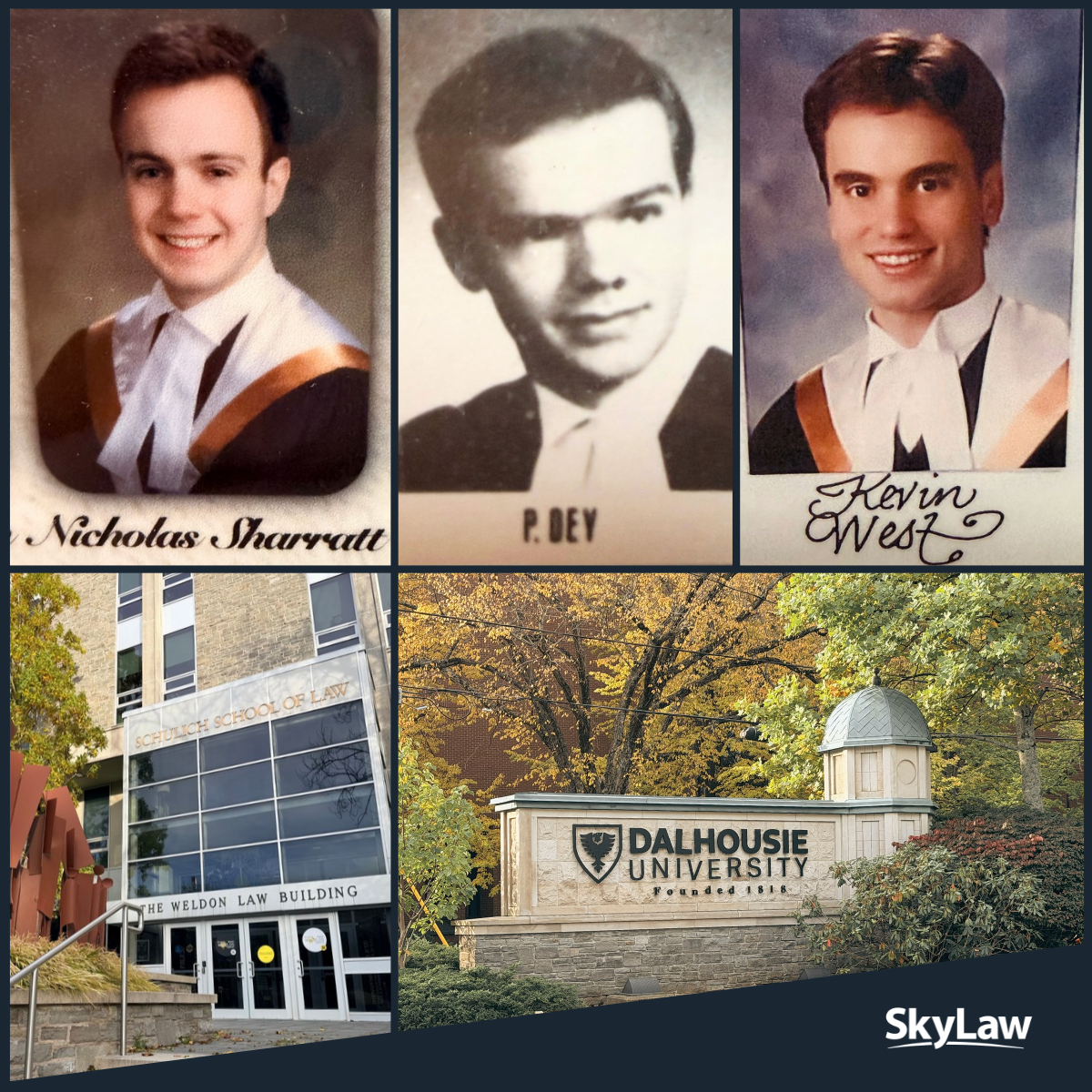
Kevin recently returned to Halifax for his third year co-teaching the Intensive Corporate Governance course at his alma mater, Dalhousie University’s law school, alongside “the godfather of corporate governance”, Peter Dey, and “the Doogie Howser of the law school”, Nicholas Sharratt. Check out their grad photos hanging in the hallowed halls of the law school as proof.
Kevin was so impressed with the 22 Dal Law students and their lively discussions on governance, transactions, AI and the evolving practice of law. Peter had incredible stories from his years in the boardroom, and a favourite quote from Nick was: "The RBC AGM is my Super Bowl.”
SkyLaw was pleased to sponsor a pizza lunch during the Saturday class, giving Kevin an opportunity to learn more about the students’ plans for the future. Judging by this group, the future of the profession is in very good hands!
The SkyLaw team takes great pride in meeting in person - even when it’s on the other side of the world! On a recent trip to Seoul and Tokyo, Esta took the opportunity to catch up with some of our international contacts at fellow law firms. She enjoyed thoughtful conversations, wonderfully warm hospitality, and some “next level” office views.
SkyLaw is proud to be the Canadian firm our international colleagues can call when their clients need help. We love building these relationships, and we’re always happy to have a reason to travel. We’d love to visit you next!